
Introduction
There are tons of different surfboard constructions on the market, all of which have pros and cons. This post is going to be focused on soft tops and some of the different constructions available.
Note: We will be covering fiberglass surfboard constructions in the near future, but we figured we would start with foamies.
Soft top Construction
Popular soft top surfboards generally feature 4 different materials: one material for the core (the inside), one for the stringer (support), one for the deck (top of the board), and another material on the bottom.
Soft Top Cores
Most soft top cores are made with Expanded Polystyrene, also known as EPS. Expanded Polystyrene is a buoyant and lightweight closed-cell foam, which means that the foam is made up of sealed cells that do not interconnect. Realistically, all you really need to know is that a board with this foam type floats well and is fairly durable.
Soft top Stringers
Additionally, the board will have stringers (or just one). A stringer is a thin piece of wood, usually balsa or maple, that acts as the surfboard’s backbone, providing extra strength. Without a stringer in a soft top, the board is going to buckle or snap in half with little stress.
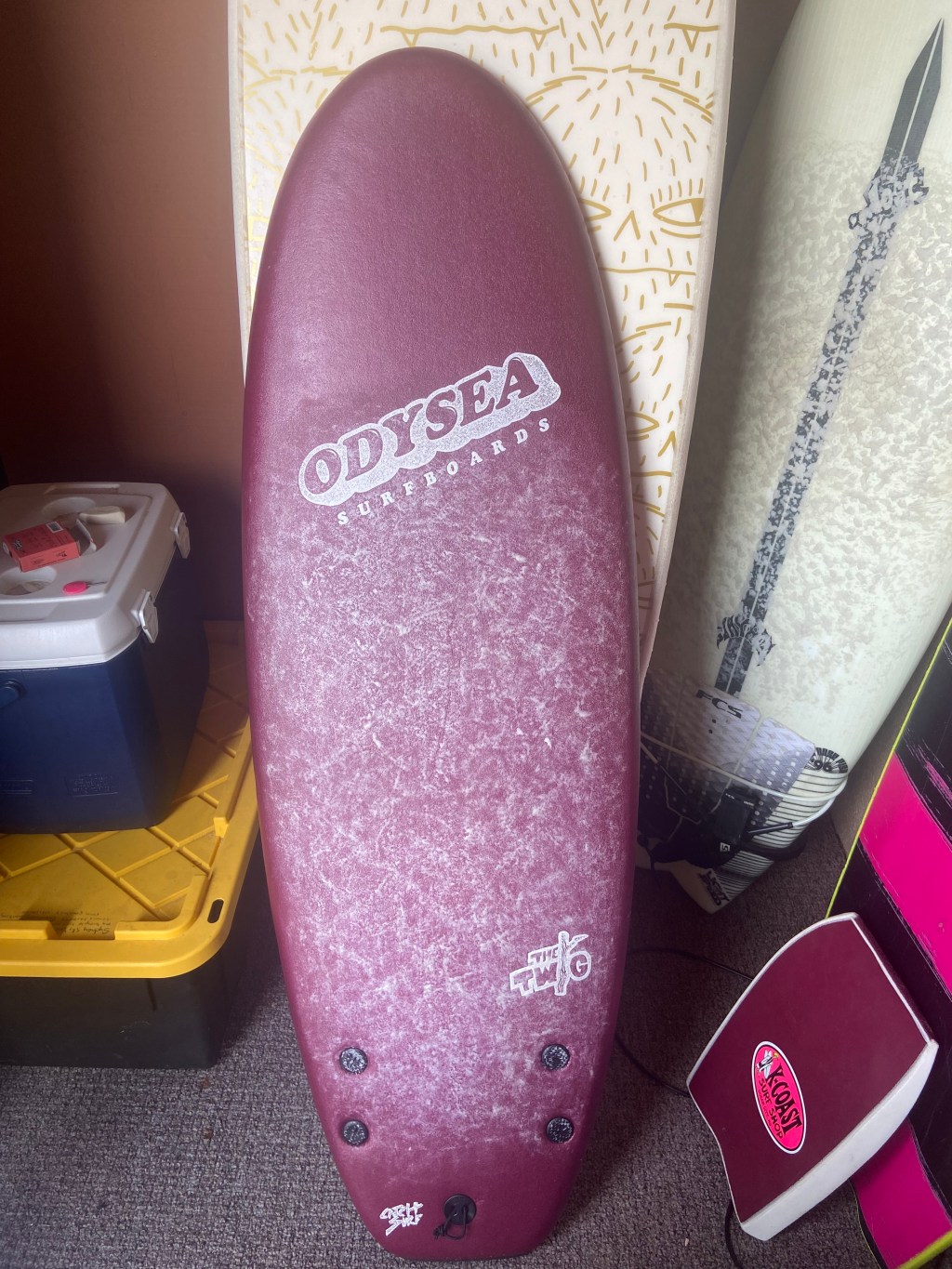
Higher end soft tops, such as the Odysea models by Catch Surf, feature triple maple stringers that run through the board, while other options may only have single or double stringers.
Soft top deck
The majority of soft tops are going to use some form of Ethylene-Vinyl Acetate (EVA) foam on the deck (top of the board where you stand). EVA is a fairly durable foam, but it is still soft, hence “soft top,” so you’re less likely to get serious injuries if you take a blow.
Some soft tops feature a textured foam, which allows you to surf with little or no wax, but we still recommend using a little wax just to be safe. Most soft tops however do not have a whole lot of texture, meaning you should use a light coat of wax on them to avoid slippin’ and slidin’.
Soft top Bottom
The bottoms of soft tops are going to normally be made of some form of high-density polyethylene (HDPE), which is a slick and fairly durable material. This material is used so that the board has less drag in the water, while also holding up fairly well.
Final note on soft tops: the evolution of soft tops (Hybrids)
Today, there are a lot more soft top options available on the market. Companies, such as Walden and Stewart for example, have partnered with manufacturers such as Surftech to create soft top versions of some of their most popular models. Stewart has now also created their own proprietary construction, “HydroCush.”
These boards bridge the gap between traditional soft tops and fiberglass surfboards, pairing EVA foam tops with hard bottoms. These boards ride very similar to a traditional fiberglass board, but the price is certainly reflective of that too (costing hundreds more than normal soft tops).
These boards are certainly worth the investment if you are looking to graduate from a classic soft top, but don’t feel you’re ready yet for a fully fiberglass board. Here are some of the hybrid boards I referenced in this last section:
Warmer days are coming!
 East Coast Surf Gear
Leave a comment